
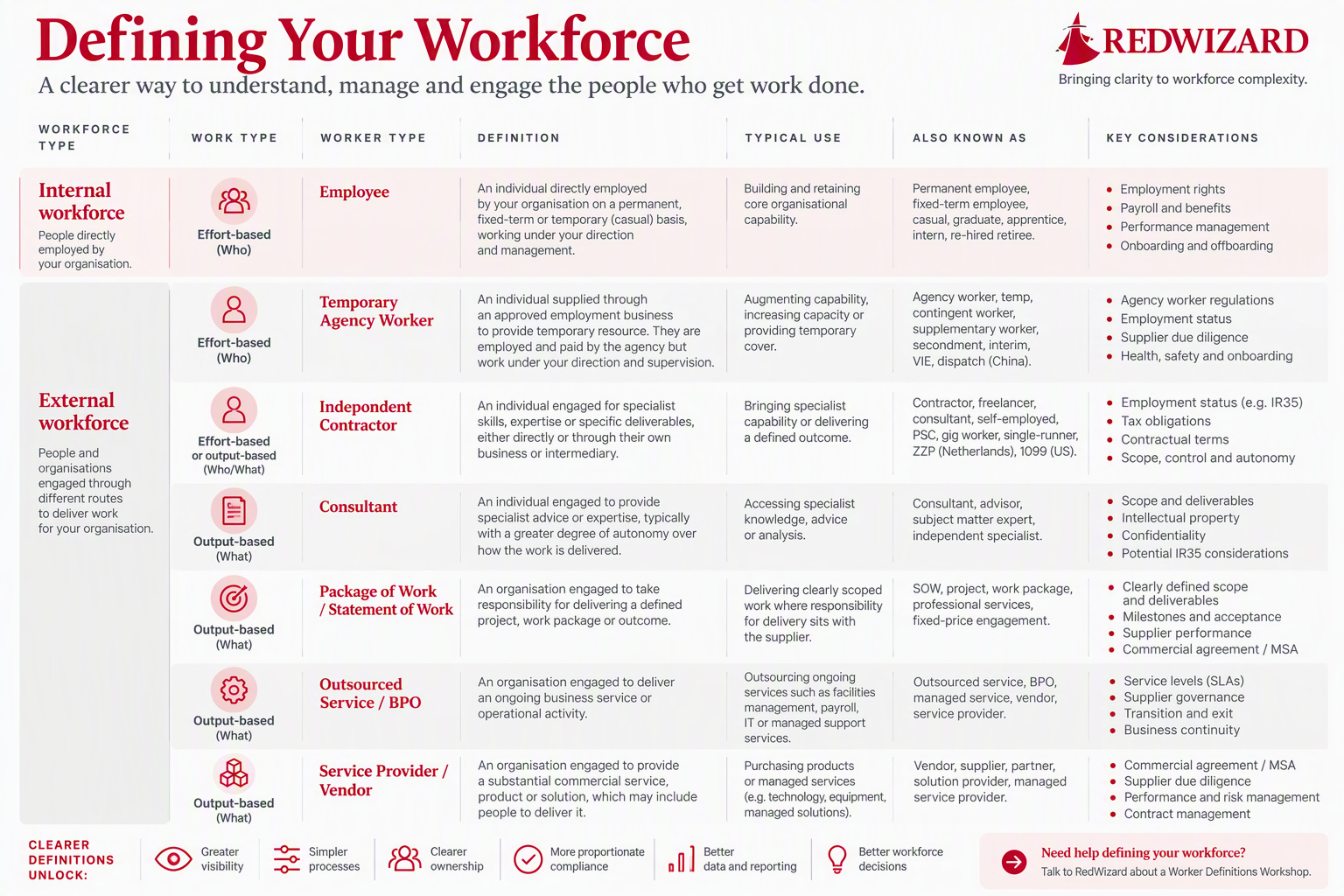
Most organisations still think about their workforce in fairly broad terms. There are employees, and then there is everyone else.
That “everyone else” can include agency workers, independent contractors, freelancers, consultants, people delivering Statements of Work and teams working for outsourced service providers. They may all be external to the organisation, but they are clearly not the same. They do different types of work, enter the organisation through different routes and need to be managed in different ways.
This distinction matters increasingly as organisations try to get a clearer view of their whole workforce. If everything outside the employee population is simply categorised as “external”, there is a limit to what that visibility can actually tell you.
Defining the different ways work is delivered is a relatively simple step, but it starts to bring some structure to what can otherwise become unnecessarily complicated.
Start with the work
When we work with organisations on worker definitions, one of the distinctions we explore is whether the organisation is fundamentally buying effort or an outcome.
Effort-based work is about accessing someone’s time, skills or capacity. They might be covering an absence, adding capacity to a team or providing specialist expertise that the organisation needs for a period of time. The organisation will typically have more involvement in directing the work and how it is delivered.
Outcome-based work is different. Here, the requirement is for a defined piece of work, deliverable or service, with the individual or supplier taking greater responsibility for achieving the result.
Written down, the distinction sounds obvious. In practice, it can become blurred very quickly.
“Contractor” is a good example. The term can be used for someone supplied through an agency, an independent professional working through their own company, a temporary member of an internal team or even somebody delivering work through a consultancy.
Statement of Work can be equally misleading. Two engagements may carry exactly the same contractual label but operate very differently in practice.
That is why we prefer to start with the work rather than the worker label. Understanding what the organisation is actually trying to achieve gives you a much better basis for deciding which type of engagement makes sense.
A little standardisation can make things much simpler
The aim isn’t to create dozens of worker types or introduce a new language that nobody understands. In fact, we generally want to do the opposite.
A sensible set of definitions gives different parts of the organisation a common language.
An organisation might choose to distinguish between employees, temporary agency workers, independent contractors, consultants, Packages or Statements of Work and outsourced services. Another organisation may use different terminology entirely.
That’s fine.
There are relevant legal, tax and industry definitions that provide important guardrails, but the operational language also has to work within the organisation using it.
What’s important is having enough clarity that when HR, Talent Acquisition, Procurement, Finance and the business talk about different parts of the workforce, they broadly understand the same thing.
That consistency starts to simplify what happens next.
It becomes easier to determine where a requirement should go, who needs to be involved, what information should be captured and how the engagement needs to be managed. It also provides a much better starting point for understanding which compliance considerations may apply.
The definition itself doesn’t determine employment or tax status, and it certainly doesn’t replace the appropriate assessment where one is needed. What it does is help people recognise the type of engagement they are dealing with and start asking the right questions.
Better definitions lead to better visibility
There is another important reason to do this.
Once an organisation has a consistent way of describing the different populations that make up its workforce, the data becomes much more useful.
Rather than reporting employees on one side and a large, rather unhelpful “external” population on the other, organisations can begin to understand how work is actually being delivered.
That can expose where external capability is being used, which engagement routes are most common, which suppliers are involved, where spend is flowing and where information or oversight is missing.
It also gives different functions a better chance of joining up their view.
HR may be interested in workforce composition and capability. Talent Acquisition may be thinking about how skills are accessed. Procurement may be looking at suppliers and commercial arrangements. Finance will have a view of cost and spend. None of those perspectives is wrong, but without common definitions it can be very difficult to bring them together.
This is why we see worker definitions as part of the foundation for whole-workforce visibility. They help create a shared language around the people and organisations actually getting the work done.
And once that visibility improves, the conversation can move beyond simply counting workers towards much more useful questions about capability, cost, risk, sourcing and how work should be delivered in the future.
Defining your workforce in practice
There isn’t a generic set of worker definitions that every organisation should simply adopt.
How work is delivered varies. Terminology varies. Supplier landscapes, operating models and geographic requirements vary too.
The useful work is in getting the right people around the table, looking at how work is actually delivered today and agreeing definitions that are simple enough to use while still providing the clarity the organisation needs.
That is what we do through our Worker Definitions Workshop.
We bring together the relevant functions and help organisations move beyond the broad internal/external divide towards a set of practical definitions that reflect how their workforce really works.
The output isn’t intended to be a glossary that gets filed away.
It’s a foundation for clearer visibility, simpler workforce management and better decisions about how work gets done.
If you’re looking to get a clearer view of your whole workforce, defining it properly is a very sensible place to start.
Talk to RedWizard about a Worker Definitions Workshop.
RedWizard | Bringing clarity to workforce complexity.
Written by:

Founder & Workforce Governance Advisor
I’m an art school graduate who ended up running a record label in Lisbon before finding my way into PMO. Not the most obvious path, but looking back, the thread is obvious. I’ve always been drawn to complex, moving-parts problems and I’ve always wanted to work differently.
That second part matters. Workforce ecosystems are built around people choosing how they work, whether that’s as employees, contractors, consultants, freelancers or service providers. I found my way into this space because I wanted that freedom myself, and now I help organisations make it work better for everyone involved.
I founded RedWizard in 2014 after realising how fragmented workforce management had become. Different functions owned different pieces of the picture, but nobody owned the whole. Coming from a PMO background, I saw that fragmentation differently to most. Where others saw complexity, I saw an opportunity to create more visibility, better decisions and stronger collaboration.
Today, my work focuses on helping organisations bring clarity to workforce complexity. I work with leaders across HR, Procurement, Finance, Legal and Operations to design practical governance, operating models and workforce capabilities that improve how decisions get made and how work gets done.
I’m at my best where complexity, ambiguity and competing stakeholder priorities need turning into something that works in practice.